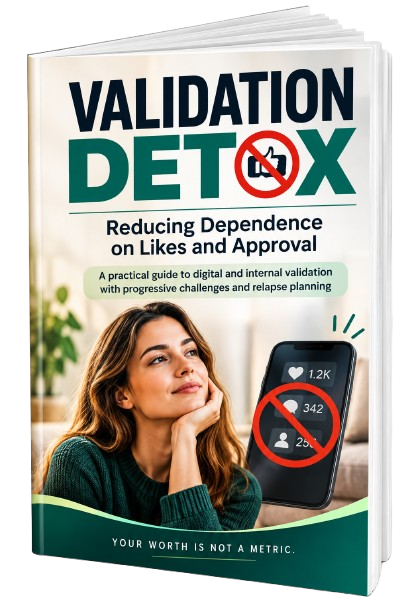
Validation Detox
Reducing Dependence on Likes and Approval
Your worth is not a metric. Learn to step back from the constant pull of likes, reactions, and approval—and build a healthier relationship with validation, one gradual step at a time.
A digital personal development ebook
When Other People’s Reactions Start to Shape Your Day
Seeking recognition is human. But when approval becomes the main measure of your worth, ordinary moments can begin to feel much heavier.
Checking for Reactions
You post something, then keep checking likes, comments, views, or notifications to see how people responded.
Waiting for a Reply
A delayed message or a quiet response leaves you wondering whether you said something wrong or upset someone.
Measuring Yourself by Numbers
A post’s performance, a follower count, or public recognition starts to feel like a score of your personal value.
Looking for Reassurance
You find yourself asking others to confirm a decision before trusting your own judgment.
Rewriting and Overthinking
You repeatedly revise a message or hold back an honest opinion because you are worried about how it will be received.
Missing the Moment
You become so focused on how an experience might look to others that it becomes harder to enjoy the experience itself.
You Don’t Have to Stop Caring. You Can Stop Letting Every Signal Define You.
Validation Detox is a practical guide to digital and internal validation. It explores how dependence on likes, comments, reactions, and other people’s approval can develop—and how to begin changing those patterns through awareness and gradual practice.
The book does not ask you to become indifferent to others or abandon every social platform. Instead, it invites you to create more space between the desire for recognition and your sense of self-worth.
Two connected patterns
- Digital validation: Checking likes, comments, views, followers, and reactions—and adjusting your mood or behavior around those signals.
- Internal validation: Looking to other people, or an imagined audience, to decide whether you are good enough, competent, or lovable.
The book connects these patterns with values, self-compassion, autonomy, and gradual changes in everyday habits.
Understand the Pattern. Practice a New Response.
The ebook moves from understanding validation dependence to observing your habits and exploring practical ways to respond differently.
Understand the Need for Approval
Explore what validation means, why recognition matters, how dependence can develop, and how digital feedback can reinforce the cycle.
Notice Your Habits and Triggers
Learn to observe checking patterns, emotional reactions, uncertainty, and the situations that prompt you to seek reassurance.
Reconnect With Your Own Criteria
Explore values, self-compassion, and autonomy as ways to develop internal reference points for decisions and self-worth.
Make Gradual Changes
Explore progressive changes to checking, posting, responding, and living with fewer public metrics—while learning how to approach setbacks.
A 24-Chapter Guide to Validation and Approval
Explore the book’s real chapter structure, from understanding the validation cycle to gradual practice, reflection, and next steps.
Go Beyond Reading. Observe Your Own Patterns.
Most chapters include a practical exercise designed to help you notice your behavior with curiosity rather than harsh judgment. The book uses simple resources such as a notebook, a calendar, device settings, and personal reflection.
- Observation logs to notice checking habits and emotional responses.
- Trigger mapping to explore what happens before you seek validation.
- Reflection prompts about approval, values, and personal rules.
- Exercises for identifying the difference between a social signal and the meaning you attach to it.
- Practical ways to reflect on your choices and daily behavior.
Change does not have to begin with a dramatic break.
The book describes a gradual process rather than an all-at-once overhaul.
Notice your habits before making major changes.
Gradually reduce checks and change how you post and respond.
Explore daily life with less reliance on public numbers and reactions.
Explore the Book’s 30, 60, and 90 Day Plan
The ebook includes a dedicated chapter for a structured plan. It encourages gradual practice, reflection, and realistic expectations rather than overnight change.
Begin With Awareness
Use the book’s observation and reflection approach to become more aware of validation habits and the situations that prompt them.
Continue With Practice
Build on the progressive changes described in the book and keep exploring your responses to feedback, checking, and approval.
Reflect and Keep Going
Use the plan as a structured path for continued reflection and practice, while recognizing that change can include setbacks.
The plan is a guide for personal practice, not a guarantee of a specific result or timeline.
Build a More Thoughtful Relationship With Approval and Self-Worth
Based on the topics and practices in the ebook, readers can explore ways to:
Recognize Validation Patterns
Understand how digital and internal validation seeking may show up in everyday life.
Notice Triggers Earlier
Explore the moments, emotions, and situations that lead to automatic checking or reassurance seeking.
Separate Signals From Self-Worth
Practice considering feedback without treating every reaction as a verdict on your value.
Explore Your Values
Reflect on personal values as an internal compass for decisions and everyday behavior.
Respond With Self-Compassion
Explore kinder ways to respond to discomfort, mistakes, and setbacks during the process.
Practice More Autonomous Choices
Reflect on making choices for your own reasons while still caring about your relationships with others.
For Anyone Who Wants to Understand Their Need for Approval
This guide may be relevant if you recognize yourself in situations such as:
- Checking social media reactions more often than you intended.
- Feeling unsettled when messages or comments do not arrive.
- Letting online numbers influence how you evaluate your work or experiences.
- Seeking reassurance before making everyday decisions.
- Adjusting your opinions or behavior to avoid disapproval.
- Wanting to use social platforms while feeling less controlled by their feedback.
Connection still matters.
Validation Detox does not treat the desire for recognition as a flaw. It distinguishes healthy connection and useful feedback from patterns in which approval begins to control your mood, choices, or sense of worth.
The goal is a healthier balance—not indifference to other people.
A Gradual, Reflective Approach—Not an All-or-Nothing Detox
Digital and Internal Validation Together
The book looks beyond social media checks to explore approval seeking in relationships, work, decisions, and self-evaluation.
Progressive Rather Than Extreme
It describes observing habits, reducing checks, changing posting and response patterns, and gradually living with fewer public metrics.
Setbacks Are Part of the Process
The book treats lapses as information to learn from, rather than proof that the effort has failed.
Practical and Personal
Its exercises use simple resources such as a notebook, reflection, calendars, and device settings—not a specific paid app or branded program.
What You Get
Validation Detox
Reducing Dependence on Likes and Approval
- The Validation Detox digital ebook
- 24 chapters covering validation, approval, habits, gradual detox, and continued practice
- Practical exercises and reflection prompts included in the book
- The book’s 30, 60, and 90 day plan
This offer is for the ebook described on this page. No additional bonuses, courses, or services are included in this offer unless separately stated by the seller.
Explore a Healthier Relationship With Validation
If you’re ready to understand your approval-seeking patterns and explore a gradual, practical approach, Validation Detox can be your starting point.
Validation Detox
Reducing Dependence on Likes and Approval
Take a gradual step toward understanding your relationship with approval.
Shop With the 7-Day Guarantee
Your Validation Detox offer includes a 7-Day Guarantee.
Please review the guarantee terms and conditions presented during checkout for the applicable details.
Questions About Validation Detox
What is Validation Detox about?
It is a personal development ebook about reducing dependence on likes and approval. It explores digital and internal validation, habits, values, self-compassion, autonomy, and gradual changes in everyday behavior.
Does the book focus only on social media?
No. It also discusses validation seeking in relationships, work, school, social groups, professional life, and everyday decisions.
Do I have to delete my social media accounts?
The book does not require you to abandon every platform. Its approach focuses on changing how you relate to social feedback and signals, with gradual adjustments that can fit your circumstances.
Does the ebook include practical exercises?
Yes. Most chapters include practical exercises, along with reflection prompts and simple tools such as observation logs and a notebook.
Does it include a structured plan?
Yes. Chapter 22 is titled “Your 30, 60 and 90 Day Plan.” The book presents a structured path for continued practice.
Is this a treatment program or a diagnosis?
No. The ebook identifies itself as a personal development book. It does not diagnose a condition or replace care from a qualified professional.
How much does Validation Detox cost?
The listed price is $9.90.
Does the offer include a guarantee?
Yes. The offer includes a 7-Day Guarantee. Review the terms and conditions presented during checkout for details.
Make Room for Your Own Values
Likes, comments, and approval can be part of life—but they don’t have to become the measure of your worth. Explore Validation Detox and begin understanding the patterns behind your need for recognition.
Validation Detox
Reducing Dependence on Likes and Approval
A practical guide to digital and internal validation with progressive challenges and relapse planning.