Learning Foundations
Understand why study methods matter more than any single tool, and explore memory, attention, effort, and the difference between familiarity and meaningful learning.
Learn how to use AI for reading, summaries, practice questions, explanations, and study planning—while keeping your own reasoning, judgment, and understanding at the center of the learning process.
AI can make information easier to access and present. But a clear explanation, a polished summary, or a familiar page does not automatically mean you can recall, explain, or apply what you studied.
Going over notes and highlighting passages can feel familiar, yet you may find it difficult to explain the ideas when the material is no longer in front of you.
When a tool does the first part of the thinking, you may miss the effort involved in remembering, connecting, and understanding the material yourself.
AI-generated information can sound confident and still be incorrect. Important claims, explanations, and references need to be checked against reliable sources.
Balancing reading, practice, review, deadlines, and rest can be difficult without a clear way to organize your sessions over time.
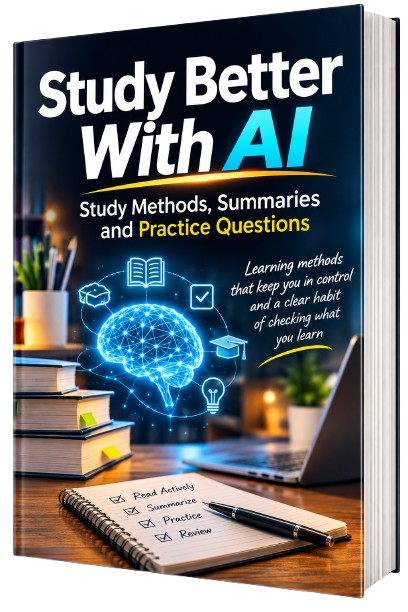
Study Better With AI explores how to bring artificial intelligence into a thoughtful study process. It connects practical learning methods with responsible AI use, helping you decide when a tool can assist—and when you need to do the thinking yourself.
Attempt first. Explain in your own words. Check your understanding against the source. Then use AI to help with the gaps you can identify.
The book moves from learning foundations to practical study methods, planning, verification, academic integrity, and wellbeing.
Understand why study methods matter more than any single tool, and explore memory, attention, effort, and the difference between familiarity and meaningful learning.
Explore active reading, useful summaries, concept maps, AI-assisted practice questions, explanations at different levels, and explaining ideas in your own words.
Learn about planning a study week, spacing reviews over time, and interleaving different topics on a calendar.
Examine how to check AI answers, ground study in your own materials, and recognize hallucinations and confident mistakes.
Work with vocabulary and precise language, approach problem solving without outsourcing it, and use writing support without losing your own voice.
Explore honesty, trust, fairness, respect, responsibility, and why AI-use rules can vary by country, school, and assessment.
Consider dependence and cognitive offloading, as well as the roles of study groups, teachers, and shared work.
Explore different learning needs, accessibility, stress, wellbeing, and when to ask other people for help.
Bring the methods together with a 30-, 60-, and 90-day plan, followed by references and further reading.
Chapter groupings follow the ebook's actual table of contents.
The guide discusses concrete ways to work with your learning materials and use AI as a supporting tool.
Set questions before reading, pause to check your understanding, recall the main ideas from memory, and compare your summary with the original source.
Organize concepts visually, label the relationships between them, and use the map to identify gaps in your understanding.
Use questions to test recall, work through problems, explain concepts in your own words, and use feedback to identify what needs another attempt.
Spread reviews across time and mix different topics or problem types instead of relying only on one long session or repeated practice of the same type.
Check important claims against your course materials and original sources. Treat fluent AI output as something to examine, not something to accept automatically.
Attempt tasks before asking for answers, request hints when appropriate, and make room for unaided practice so important skills remain yours.
The ebook's final practical chapter brings its methods together in a roadmap designed to help you try, review, and adjust your study habits over time.
Focus on routines, active reading, and explanation. Begin with a manageable schedule and consider whether you can sustain two or three study sessions each week.
Bring in practice questions, concept maps, spacing, and mixed-topic practice. Compare what you can do with assistance and what you can do independently.
Review your progress, identify useful methods, and decide which routines should become part of your ongoing approach to learning.
The book presents this as a framework for deliberate practice and adjustment—not a promise of grades, results, or a particular outcome.
The methods and guidance in this ebook can help you approach your study sessions with clearer goals, more active practice, and a stronger habit of checking your work.
Use recall and explanation to look beyond the feeling of familiarity and examine what you can actually do.
Define what you want to learn, what evidence will show progress, and what kind of support you need.
Explore ways to use AI for explanations, examples, questions, and feedback without handing over the learning process.
Develop a habit of comparing important AI-generated claims with your own materials and reliable sources.
Explore weekly planning, spaced reviews, and interleaving to give your study routine a clearer structure.
Consider academic integrity, dependence, independent practice, and the role of people in your learning.
A focused digital reading resource covering study methods and the responsible use of artificial intelligence in learning.
Study Methods, Summaries and Practice Questions
The digital ebook includes 24 chapters covering learning foundations, practical study methods, AI-assisted study activities, planning, verification, academic integrity, accessibility, wellbeing, and a 30-, 60-, and 90-day plan.
ONE DIGITAL EBOOKIts topics are relevant to learners who want to examine their study methods and make thoughtful use of AI.
Rather than focusing on one particular AI product, the ebook discusses habits and questions that can apply across different AI systems.
The focus is on learning principles and study habits that remain relevant even as AI tools, features, and platforms change.
The guide gives attention to checking answers, using original materials, recognizing confident errors, and understanding source limitations.
Independent thinking, academic integrity, personal responsibility, collaboration, and wellbeing remain part of the learning process.
Explore practical study methods, thoughtful ways to use AI, and a structured plan for putting what you learn into practice.
Your offer includes a 7-Day Guarantee. The guarantee period is presented here as supplied with the product offer. For the applicable terms and instructions, refer to the information provided during checkout.
A few details about the ebook and the subjects it covers.
It is a guide to study methods and the responsible use of AI in learning. It covers active reading, summaries, concept maps, practice questions, explanations, study planning, verification, academic integrity, and wellbeing.
The ebook contains 24 chapters, moving from learning foundations and study methods to planning, verification, academic integrity, people and wellbeing, and a 30-, 60-, and 90-day plan.
No. The guide does not recommend particular products, platforms, or courses. It focuses on methods and questions that can apply to different AI systems.
Yes. Topics include active reading, memory-first summaries, concept maps, practice questions, self-explanation, spaced study, interleaving, checking AI answers, and planning your study week.
Yes. Several chapters address verification, grounding study in your own materials, recognizing hallucinations and confident mistakes, and checking sources before relying on information.
Yes. Chapter 23 presents a 30-, 60-, and 90-day framework for building routines, practicing methods, reviewing progress, and deciding which methods to continue using.
No. The ebook makes no promise about grades or results. It presents study methods and responsible AI-use guidance, while recognizing that learning outcomes depend on many factors.
The offer is for the digital ebook Study Better With AI: Study Methods, Summaries and Practice Questions.
The listed price is $9.90, and the offer includes a 7-Day Guarantee. Refer to the checkout information for the applicable guarantee terms.
Explore study methods for reading, understanding, practicing, reviewing, and checking what you learn. Study Better With AI brings these ideas together in one practical digital guide.
7-Day Guarantee