Orders Outpace Capacity
New commitments arrive before you have a clear picture of available time, materials, equipment, or the team's ability to complete the work.
Learn how to connect sales growth with real operational capacity, clearer processes, and more deliberate business decisions—so you can pursue new opportunities without overlooking the work required to deliver them.
A practical guide to growing with intention—not simply taking on more work.
A busy month can look like progress on paper while putting pressure on the people and processes responsible for delivering the work.
New commitments arrive before you have a clear picture of available time, materials, equipment, or the team's ability to complete the work.
Work takes longer than expected, delivery dates slip, and customers start asking for updates that interrupt the team's daily work.
Rushed work, skipped checks, unclear instructions, and repeated corrections can consume time that should be available for new work.
When priorities, approvals, and essential knowledge remain concentrated in one person, everyday decisions can become a bottleneck.
The work may be completed before payment arrives, creating a gap between the costs of fulfilling orders and the money coming in.
Overtime, rework, complaints, and constant urgent requests can take attention away from planning and productive delivery.
Healthy growth is about more than revenue. It also means understanding what your business can deliver, making realistic commitments, protecting quality, and keeping the work manageable for the people who do it.
Strategies to Grow Sales Without Adding Operational Chaos is a practical guide for small business owners, managers, and team leaders who want to think more clearly about growth and the work required to support it.
Instead of focusing on sales alone, the book explores how capacity, sales decisions, delivery standards, people, suppliers, and cash flow work together.
The central idea is straightforward: understand your limits, choose work deliberately, and build routines that help your business make and keep realistic commitments.
The book follows the connected decisions involved in growing a small business—from understanding capacity to reviewing progress and planning the next steps.
Understand why sales growth can strain operations, measure real capacity, and identify the bottleneck limiting the flow of work.
Explore pipeline management, demand forecasting, lead qualification, sustainable pricing, and offer priorities.
Consider how to package deliverable offers, standardize recurring work, write useful instructions, and check quality.
Work through realistic timelines, expectation management, change requests, and the handoff from sales to operations.
Explore staffing, hiring, cross-training, and working with suppliers and subcontractors as demand changes.
Consider cash flow during growth, when to decline a large order, and how to recognize signs of operational overload.
Learn why simple records and consistent reviews can help make operational decisions easier to understand and evaluate.
Bring the guide's main ideas into a planning framework that you can adapt to your own business and circumstances.
The eBook contains 24 numbered chapters, including an introduction and a final references and further reading chapter. The topics above are grouped for easy browsing.
Alongside explanations and examples, the book includes practical resources designed to help readers examine their own processes and decisions.
Short checklists at the end of chapters help bring attention to the key points covered in each topic.
Illustrative examples and tables show ways to think through capacity, bottlenecks, planning, and operational choices.
A planning framework brings together the guide's main ideas so you can consider what to address first and how to review your progress.
The book explains that many tables can be copied into a notebook or spreadsheet. It does not require specialized software to apply its ideas.
The guide includes a dedicated 30, 60, and 90-day planning chapter. Its broader approach encourages small, measured changes rather than trying to reorganize everything at once.
Start by examining a specific area of the business, understanding the friction people experience, and looking at the capacity or process constraints affecting the work.
The book emphasizes trying changes for a defined period, recording what happens, and learning from the results before deciding whether to keep or adjust a new practice.
Use simple records and regular reviews to compare expectations with actual results, reassess priorities, and decide which operational issues need further attention.
These are broad themes from the book's planning approach, not a guarantee of results or a substitute for decisions based on your own business data.
The guide offers ways to think about common operational challenges and make more informed decisions as your business changes.
Consider staff time, equipment, materials, management attention, and customer communication when evaluating how much work you can take on.
Look for queues, waiting time, and recurring delays to identify where work is being held up.
Connect lead qualification, demand forecasting, pricing, and offer priorities with the business's ability to deliver.
Explore practical ways to document recurring processes, write work instructions, and establish quality checks.
Consider how timelines, scope changes, customer updates, and sales-to-operations handoffs affect delivery.
Look at measures such as delivery performance, errors, overtime, open commitments, and cash flow alongside sales.
Use repeatable records and reviews to compare planned work with actual outcomes and spot assumptions that need adjustment.
Use the book's topics to select an operational issue to investigate instead of trying to change everything at once.
These are areas the book is designed to help readers understand and evaluate. Actual outcomes depend on your business, decisions, and execution.
Your purchase is for the digital book: Strategies to Grow Sales Without Adding Operational Chaos.
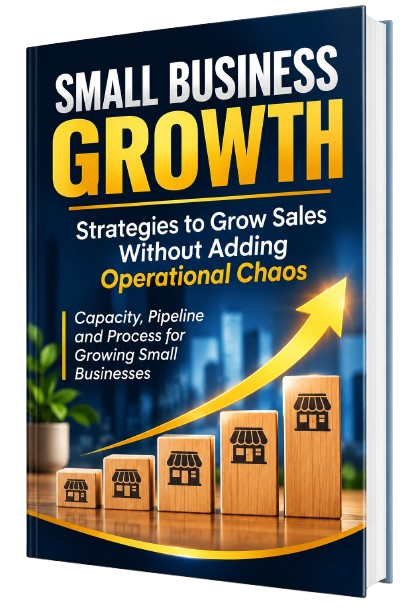
Strategies to Grow Sales Without Adding Operational Chaos
The book is written for owners, managers, and team leaders of small businesses who want to balance new sales opportunities with reliable day-to-day operations.
For founders who want to understand how much work their business can realistically handle before committing to more orders or customers.
For people coordinating priorities, capacity, handoffs, timelines, and the work required to meet customer commitments.
For service firms and agencies that need to think about skilled people, clear project scope, realistic timelines, and review cycles.
For shops, manufacturers, food producers, and online sellers managing orders, inventory, equipment, suppliers, fulfillment, or customer messages.
The guide connects commercial decisions with the operational responsibilities that follow each sale.
Consider the resources, constraints, and delivery requirements behind a sale—not just the revenue it represents.
The book emphasizes practical processes, usable instructions, and basic records that small teams can maintain.
Use examples as starting points, adapt ideas to your circumstances, and review changes against your own business data.
The book provides general information, not individual consulting or a promise of results. It encourages readers to adapt the ideas to their own customers, team, suppliers, margins, and local requirements.
Explore a practical approach to capacity, sales planning, delivery processes, customer commitments, and the routines that support a growing small business.
Whether your immediate concern is missed deadlines, overloaded staff, unclear processes, or deciding which work to accept, the book provides topics and examples you can explore in the context of your business.
eBook offer
Take the next step toward more deliberate business growth.
This offer includes a 7-Day Guarantee. The guarantee period is presented here as provided with the offer. Please review the applicable purchase and refund terms during checkout for the specific conditions.
Here are a few details to help you decide whether this guide fits what you're looking for.
It explores how small businesses can approach sales growth while keeping operations manageable. Topics include capacity, bottlenecks, sales pipelines, forecasting, pricing, delivery processes, quality, staffing, suppliers, cash flow, and planning.
It is written for owners, managers, and team leaders of small businesses, including service firms, retail shops, manufacturers, food producers, agencies, and online sellers.
Yes. The book includes chapter checklists, tables, illustrative examples, and a 30, 60, and 90-day planning framework. It also explains that many tables can be copied into a notebook or spreadsheet.
The book states that specialized software is not necessary for most of its ideas. A paper notebook, a shared document, or a basic spreadsheet can be enough for many small teams.
No. The book explicitly states that it provides general information, not individual consulting or a promise of results. Outcomes depend on factors such as your business, market, customers, and execution.
The listed offer price is $9.90.
Yes. The offer specifies a 7-Day Guarantee. Please review the applicable terms during checkout for the specific conditions.
The book encourages readers to adapt its ideas to their own customers, team, suppliers, margins, and work patterns rather than copying examples word for word. Decisions with legal, tax, employment, or financial consequences may require advice from a qualified professional familiar with your location.
Explore how capacity, sales decisions, delivery processes, and simple routines fit together in Strategies to Grow Sales Without Adding Operational Chaos.
Practical information for small business owners, managers, and team leaders.