01
Understand the Debt Cycle
Explore why debt returns, how recurring patterns develop, and the four parts of a borrowing loop: trigger, action, reward, and consequence.
Understanding why debt keeps returning is the first step toward changing the pattern. Explore the emotional triggers, everyday pressures, and practical habits that can make borrowing repeat — and learn how to approach your next financial decisions with greater awareness.
Debt can return for reasons that are bigger than a single purchase. Everyday situations, emotional pressure, and financial gaps can combine to restart the same borrowing pattern.
You finally pay off a credit card or personal loan, but a new balance begins building a few months later.
An unexpected repair, medical bill, or school expense arrives, and borrowing feels like the only available option.
Your income changes from month to month, making it difficult to plan around bills and payment dates.
Stress, loneliness, boredom, guilt, or even celebration can influence the way you spend.
Small installments and minimum payments make individual balances seem manageable while the total becomes harder to track.
One setback makes you feel discouraged, and it becomes harder to return to the financial plan you had started.
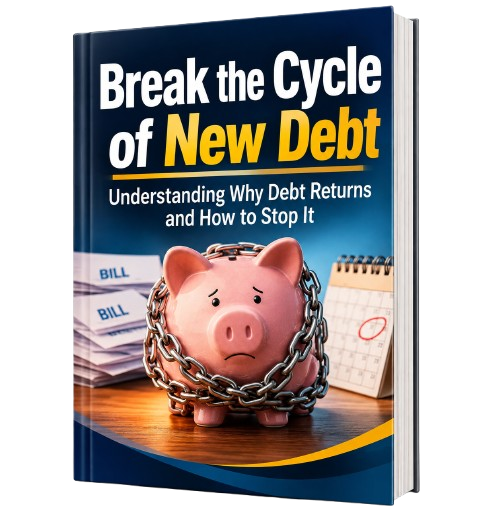
Break the Cycle of New Debt: Understanding Why Debt Returns and How to Stop It is a practical personal finance guide for adults who want to understand why borrowing returns and what may be keeping the pattern going.
The book presents debt as a repeating pattern rather than a personal flaw. It explores how emotional triggers, unstable income, limited savings, easy access to credit, and everyday decisions can interact.
Instead of focusing only on what happens after a balance grows, the guide looks at the moments before a borrowing decision — where a pause, a different response, or better preparation may create another option.
The chapters move from understanding recurring borrowing to exploring practical changes, financial preparation, support, and ways to maintain progress.
Explore why debt returns, how recurring patterns develop, and the four parts of a borrowing loop: trigger, action, reward, and consequence.
Understand how stress, loneliness, boredom, celebration, guilt, and shame can influence spending and borrowing decisions.
Explore the connection between irregular income, cash-flow gaps, unexpected expenses, and the absence of an emergency reserve.
Learn about cooling-off rules, changes to your spending environment, planned purchases, and ways to make impulsive borrowing less automatic.
Explore flexible budgeting for variable income, rebuilding an emergency reserve, planning ahead, and protecting money set aside for unexpected costs.
Address setbacks, household money conversations, credit reports and scores, support options, consumer protection, and ongoing financial habits.
The book also includes a final References and Further Reading chapter.
The guide includes practical exercises, checklists, reflection questions, and comparison tables to help readers examine their own financial patterns.
Organize borrowing events, balances, reasons, and recurring patterns to create a clearer picture of your debt history.
Reflect on the feelings, situations, actions, and consequences that may be connected to repeated borrowing.
Use the checklists at the end of chapters to review key ideas and identify steps to consider in your own circumstances.
Review tables that organize common triggers, spending patterns, options, and practical responses discussed in the guide.
Explore reflection questions and cooling-off approaches that create time to consider a purchase before committing.
Use the book's review suggestions to revisit financial goals, notice setbacks, and adjust your next steps over time.
The book includes a dedicated chapter for organizing practical steps across three time horizons, while adapting the process to your own circumstances.
Begin by examining your debts, spending patterns, financial pressures, and the warning signs that may precede another borrowing decision.
Work with the guide's ideas for spending barriers, purchase planning, flexible budgeting, and preparation for unexpected expenses.
Review the steps you have tested, consider what needs adjustment, and identify the habits and priorities you want to continue.
This is a planning framework presented in the book, not a promise of a particular financial result. Your steps and timing should reflect your circumstances.
The content is designed to help you understand your financial patterns and consider practical responses — without promising instant fixes or guaranteed outcomes.
Your purchase is for the digital edition of the book.
The digital edition of Understanding Why Debt Returns and How to Stop It, covering the borrowing cycle, emotional triggers, practical barriers, budgeting, emergency reserves, setbacks, support, consumer protection, and the 30, 60 and 90 day plan.
The book is written for adults who want to understand why borrowing keeps returning and are ready to examine the pattern step by step.
For adults who have repaid a credit card balance or personal loan and worry that another balance may appear.
For people who manage changing paychecks, recurring cash-flow gaps, or expenses that are difficult to predict.
For readers who want to understand how stress, boredom, loneliness, guilt, or other feelings can affect money decisions.
For households that want to approach money conversations more openly and consider shared financial routines.
This guide is intended for general education. It is not written for readers in immediate crisis and does not replace individualized financial or professional advice.
The book connects behavior, everyday financial pressures, and practical preparation instead of treating every new balance as an isolated event.
Explores how emotions, habits, immediate rewards, and financial decisions can interact in a recurring borrowing pattern.
Focuses on recognizing triggers, creating pauses, changing spending environments, and planning purchases before committing.
Addresses variable income, emergency reserves, planned costs, and the financial pressure created by unexpected bills.
Discusses setbacks, ongoing reviews, household conversations, and realistic changes that can be revisited over time.
Explore the patterns behind recurring borrowing and practical ways to approach your financial decisions with greater awareness.
Break the Cycle of New Debt · $9.90 · 7-Day Guarantee
Your purchase comes with a 7-Day Guarantee. You can review the applicable guarantee information and terms through the purchase platform.
A few important details about the book and its content.
If debt keeps returning after you have worked to pay it off, looking at the pattern behind each new balance can be a useful place to begin. Explore Break the Cycle of New Debt and its practical approach to borrowing, spending, planning, and financial habits.