Make Everyday Business Work Clearer, More Consistent, and Easier to Manage.
A practical guide to using AI for daily operations and customer communication—while keeping human judgment, accuracy, and customer data protection at the center of every workflow.
Small Tasks Can Take Up a Surprisingly Large Part of the Workday.
Running a small business often means switching between customer messages, paperwork, quotes, scheduling, and the details that keep daily operations moving.
Answering the same customer questions across different channels, day after day.
Preparing quotes, estimates, and written offers while trying to keep details accurate.
Keeping up with reviews, complaints, appointment reminders, and follow-up messages.
Finding the right document, keeping versions current, and organizing shared information.
AI can assist with parts of this work. But a polished draft is not automatically a correct one. This guide focuses on using AI as support—not as a replacement for the person responsible for the result.
Use AI Where It Can Help. Keep People in Charge.
AI for Small Businesses is a practical guide for owners, managers, and staff who want to improve routine operations and customer contact without overlooking accuracy, privacy, or responsibility.
Start With Real Work
Identify repeated tasks in your business and understand where AI-supported drafts or organization may fit into an existing process.
Improve Customer Contact
Explore workflows for questions, messages, complaints, reviews, scheduling, quotes, and written proposals.
Protect Trust and Information
Learn why human review, careful handling of customer data, access controls, and clear team rules matter.
A Clear Guide Across 23 Practical Chapters.
The book is organized into four stages, moving from the basics of AI-supported routines to customer communication, business documents, data protection, team practices, and measurement.
Build the Right Foundations
Understand how AI tools work, map daily routines, establish human review, and organize customer contact across channels.
Handle Customer Communication
Work through frequent questions, complaints, online reviews, operational lessons from feedback, scheduling, and booking messages.
Keep Documents and Teams Aligned
Explore quotes, estimates, proposals, document consistency, file organization, safe summaries, and team handoffs.
Protect Data and Improve Practices
Cover sensitive customer data, privacy rules, safe AI use, access control, incident response, team training, and measurement.
The ebook also includes a References and Further Reading chapter.
Ideas You Can Connect to Everyday Tasks.
The chapters include practical supporting material to help readers think through workflows, keep information consistent, and review AI-assisted work.
Checklists and Tables
Practical references for reviewing tasks, information, and the steps that should remain under human responsibility.
Templates and Examples
Examples related to customer messages, requests, communication routines, and keeping a consistent business voice.
Short Plans and Planning Guidance
Guidance for starting with a manageable task, reviewing what happens, and deciding what makes sense to improve next.
A 30-, 60-, and 90-Day Framework for Measuring Progress.
The final practical chapter brings measurement and implementation together in a staged plan. The focus is on learning what works in your own business—not assuming every AI task will be suitable.
Start Small
Identify a routine task and a suitable workflow. Establish the information, review steps, and shared rules needed to test it carefully.
Review the Process
Use what you learn from the initial work to assess the process, identify corrections, and refine the way the team uses it.
Measure and Decide
Review the results and decide whether the workflow should be maintained, adjusted, expanded, or left as a manual task.
Build Better Habits Around the Work You Already Do.
The guide is designed to help you make informed decisions about where AI may support your business—and where careful human attention remains essential.
Recognize Suitable Tasks
Learn to distinguish language and organization tasks from work that depends on verified business facts, calculations, or specific obligations.
Review Messages More Carefully
Understand how to check AI-assisted replies, quotes, and customer-facing documents before they leave your business.
Keep Communication Consistent
Explore approved templates, shared answers, and written rules that help a team work from the same information.
Handle Information Responsibly
Recognize sensitive customer information and learn why data minimization and access control matter.
Support Better Team Handoffs
Explore shared notes, document organization, and clearer ways to keep work understandable across a small team.
Evaluate What Is Working
Use measurement and a staged plan to assess whether an AI-supported routine is useful for your business.
Created for the People Who Keep Small Businesses Moving.
The book is written for owners and managers of small businesses, as well as the staff who communicate with customers and keep everyday operations organized.
Business Owners and Managers
For people balancing customer contact, quotes, daily routines, documents, and team responsibilities.
Customer-Facing Staff
For team members who answer calls, write emails, respond to reviews, and prepare customer messages.
Small Teams Across Industries
The examples are broadly applicable to businesses such as salons, plumbing companies, bakeries, dental offices, accounting practices, and online shops.
No technical background is assumed. The book is intended for readers who can write an email and work with a spreadsheet.
Practical Guidance Without the Hype.
The book takes a measured approach to AI: understand what the tools can do, recognize their limits, and build a process that people can review.
Human Oversight Is Central
AI-supported messages and documents are treated as drafts until a person checks them.
Focused on Everyday Operations
The content concentrates on routine work and customer contact rather than broad claims about transforming an entire business.
Privacy Is Part of the Process
Customer data, privacy differences, security, and access controls are addressed as essential parts of responsible use.
What You Get
A focused digital ebook covering practical AI workflows for daily small-business operations and customer contact.
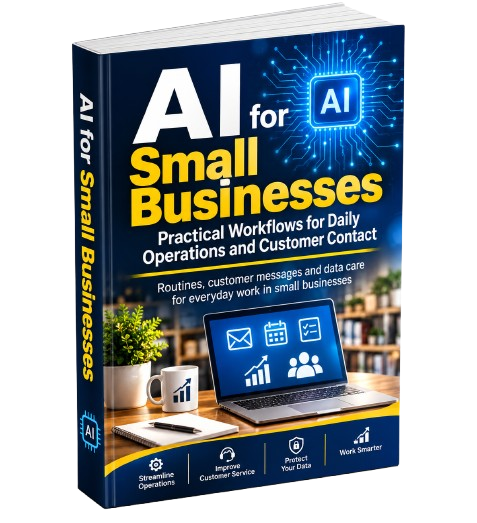
AI for Small Businesses
Practical Workflows for Daily Operations and Customer Contact
- One digital ebook
- Practical workflows, examples, checklists, and tables included in the book
- Coverage of customer communication, operations, and data care
- A 30-, 60-, and 90-day planning framework
The purchase is for the ebook described above.
7-Day Guarantee
Your purchase includes a 7-Day Guarantee.
The offer provided for this product specifies a 7-Day Guarantee. Please review the applicable purchase and guarantee information presented during checkout.
Frequently Asked Questions
What is this ebook about?
It explains practical ways small businesses can use AI to support everyday operations and customer contact, while maintaining human review and responsible data practices.
Who is this book written for?
It is written for small-business owners and managers, as well as staff who answer calls, write emails, prepare quotes, and organize business paperwork. No technical background is assumed.
What topics does it cover?
Topics include customer messages, frequent questions, complaints, online reviews, scheduling, quotes, proposals, document organization, team handoffs, sensitive customer data, privacy, security, training, and measurement.
Does the ebook include practical resources?
Yes. The chapters include practical material such as checklists, tables, templates, examples, and short plans.
Does it include a 30-, 60-, and 90-day plan?
Yes. Chapter 23 covers measuring results and a 30-, 60-, and 90-day plan.
Do I need technical experience to follow the book?
No technical background is assumed. The book is written for readers who can write an email and open a spreadsheet.
Does it recommend specific AI software?
No. The book describes categories of tools and relevant features rather than recommending specific software, companies, or subscription plans.
Does the ebook provide legal or financial advice?
No. It does not provide legal, tax, accounting, or financial advice. For decisions with legal or financial consequences, the book recommends speaking with a qualified professional in your location.
What is the price?
The listed price is $9.90, and the offer includes a 7-Day Guarantee.
Bring More Clarity to Your Everyday Business Routines.
Explore practical ways to use AI for customer communication, daily operations, and better-organized work—without losing sight of accuracy, human responsibility, or customer privacy.
AI for Small Businesses: Practical Workflows for Daily Operations and Customer Contact