Keep Conversations Going Naturally.
Learn practical ways to listen with attention, ask better questions, find everyday topics, handle awkward pauses, and bring conversations to a natural close.
When You Know You Want to Talk, but Don't Know What to Say
Everyday conversations can feel harder than they look. Sometimes, a small moment is all it takes to leave you wondering what to say next.
Running Out of Words
You reach the end of a topic and struggle to find a natural way to keep the exchange moving.
Awkward Pauses
A silence appears, and you feel pressure to fill every moment instead of allowing the conversation to breathe.
Questions That Go Nowhere
You ask something, receive a short answer, and are unsure how to build on what the other person said.
Talking Too Much or Too Little
It can be difficult to find a comfortable balance between sharing your own thoughts and giving someone else room.
Uncertain Social Moments
Meeting new people, joining a group, or speaking at work can bring different conversational challenges.
Not Knowing How to Wrap Up
You want to end a conversation politely without making the moment feel abrupt or uncomfortable.
Conversation Is a Skill You Can Practice.
How to Keep a Conversation Going Without Running Out of Things to Say is a practical guide to the small behaviors that help everyday conversations flow.
Rather than asking you to become someone else or memorize a script, it explores how to pay attention, respond to what people actually say, ask questions that invite real answers, and adapt to the moment.
The ideas are designed for ordinary situations—from brief exchanges in shops and cafés to conversations with friends, colleagues, and new acquaintances.
GET YOUR COPYListen Before You Reply
Give the other person room to finish, notice the main point, and respond to what was actually said.
Ask With Genuine Curiosity
Use open questions and relevant follow-ups to invite fuller answers without turning a conversation into an interview.
Keep the Exchange Balanced
Share in proportion, notice the other person's interest, and use natural transitions when a topic changes.
Explore the Topics Covered in the Guide
The guide moves from conversation foundations to practical situations, with chapters on listening, questions, topics, tone, social settings, and graceful endings.
Ideas You Can Bring Into Real Conversations.
The guide uses everyday examples, suggested phrases, comparison tables, and chapter checklists to make communication concepts easier to understand and try in daily life.
You can explore a topic in order or return to a chapter when a particular situation comes up.
- Examples of open questions and follow-up questions.
- Ways to show that you are listening and understanding.
- Suggested phrases for changing topics and handling interruptions.
- Checklists that help you reflect on specific communication habits.
- A quick reference with key reminders for everyday talk.
Notice What Is Happening
Start from the shared setting, the other person's comment, or a detail that gives the conversation a natural direction.
Listen and Follow Up
Let the other person finish, pick up on a detail, and ask a question that grows from their answer.
Reflect and Adjust
Use the guide's checklists and reflection suggestions to notice what feels natural and what you may want to practice next.
Build Your Practice One Stage at a Time
Chapter 23 presents a 30-, 60-, and 90-day plan that encourages small, realistic steps and regular reflection.
Build Awareness
Begin with the foundations: notice your current habits, practice listening, and try small conversation skills in ordinary situations.
Practice Balance
Continue developing questions, sharing, and conversational rhythm while observing how different interactions unfold.
Keep What Works
Review your progress, identify useful habits, and decide which practices you want to continue in everyday conversations.
Develop a More Thoughtful Approach to Everyday Talk
The guide focuses on practical communication behaviors you can understand, adapt, and practice at your own pace.
Listen With More Attention
Explore ways to understand the speaker's main point before preparing your response.
Ask More Inviting Questions
Learn how open questions and relevant follow-ups can give people room to share.
Find Natural Topics
Use everyday settings, shared experiences, and recent comments as starting points for conversation.
Balance Speaking and Listening
Explore ways to share about yourself while leaving space for the other person.
Handle Pauses More Comfortably
Understand why silence is not automatically a sign that a conversation has gone wrong.
End Conversations With Care
Learn about friendly closings, small courtesies, and ways to leave an exchange naturally.
For Different Personalities and Everyday Situations
You do not need to be shy or outgoing to explore these skills. The guide focuses on behaviors you can choose and adapt—not a personality you are expected to become.
- People who are naturally quiet and want to participate more comfortably.
- Talkative people who want to keep conversations balanced and notice others' interest.
- People who sometimes feel stuck when a conversation stalls.
- Those getting used to small talk in a new country or city.
- People starting school, changing jobs, or meeting new people in a new stage of life.
- Anyone interested in becoming more attentive and thoughtful in everyday interactions.
Practical Skills, Not a New Personality
The focus is on small, concrete behaviors that can be adapted to your own communication style and the situation around you.
Everyday Situations
Examples draw on familiar interactions at work, school, shops, cafés, social gatherings, and with people you already know.
Flexible Suggestions
The guide encourages you to adapt suggestions to your culture, relationships, and personal style instead of following rigid scripts.
Foundations Through Practice
Topics progress from listening and turn-taking to questions, difficult moments, specific settings, and conversation endings.
Reflection Along the Way
Checklists, examples, and a 30-, 60-, and 90-day plan provide ways to reflect on what you practice and what feels useful.
One Complete eBook to Explore at Your Own Pace
A focused digital guide to keeping everyday conversations moving through listening, questions, shared topics, and thoughtful responses.
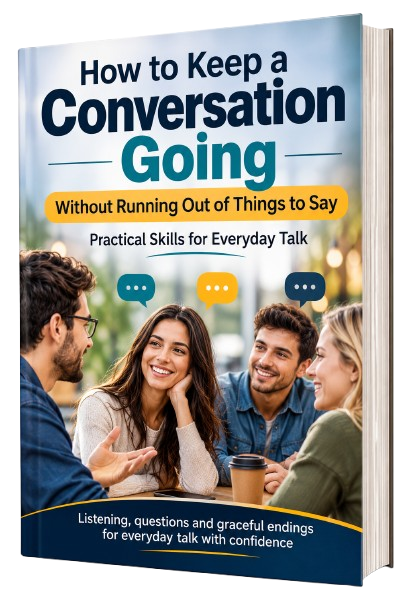
How to Keep a Conversation Going Without Running Out of Things to Say
Practical Skills for Everyday Talk
- The complete 232-page digital eBook.
- 24 chapters, including references and further reading.
- Everyday examples, suggested phrases, and chapter checklists.
- A 30-, 60-, and 90-day practice plan.
The purchase includes the eBook described above.
Make Everyday Conversations Feel Less Like a Guessing Game
Explore practical ways to listen, ask, respond, and connect—one everyday conversation at a time.
How to Keep a Conversation Going
$9.90Get the complete eBook and explore its practical guidance at your own pace.
Secure checkout through Hotmart.
7-Day Guarantee
Your purchase is offered with a 7-Day Guarantee. This gives you a seven-day guarantee period associated with the offer.
For the applicable terms and conditions, please refer to the information presented during checkout.
7-Day Guarantee
A clearly stated guarantee period is included with this offer.
Questions About the eBook
What is this eBook about?
It is a practical guide to everyday conversation skills, including active listening, open questions, follow-up questions, finding topics, handling pauses, and ending conversations naturally.
Who is this guide for?
It is written for a wide range of readers, including quiet people who want to participate more comfortably, talkative people who want better balance, people meeting new people, and anyone who wants to feel less stuck when a conversation stalls.
How many pages and chapters does it include?
The eBook contains 232 pages and 24 chapters, including a final chapter with references and further reading.
Does it include practical examples?
Yes. The guide includes everyday examples, suggested phrases, comparison tables, chapter checklists, and a quick reference.
Does it include a practice plan?
Yes. Chapter 23 presents a 30-, 60-, and 90-day plan for gradually practicing and reflecting on everyday conversation skills.
Do I need to be shy to benefit from it?
No. The guide is intended for different personalities and focuses on communication behaviors that readers can adapt to their own style.
Is this eBook therapy or professional treatment?
No. It is an educational guide for general personal development. It does not provide therapy, counseling, or diagnosis, and it does not replace care from a qualified health professional.
What is the price?
The listed price is $9.90.
Does the offer include a guarantee?
Yes. The offer includes a 7-Day Guarantee. Please review the applicable terms presented during checkout.
What will I receive with my purchase?
The product offered on this page is the digital eBook, How to Keep a Conversation Going Without Running Out of Things to Say.
You Don't Need a Perfect Line. You Can Start by Listening.
Explore practical ways to keep everyday conversations flowing, respond with genuine interest, handle quiet moments, and close conversations with care.