What to Post When Your Goal Is to Attract Clients
A practical guide to planning content that builds trust, creates clarity and supports real client conversations — without pressure, hype or invented proof.
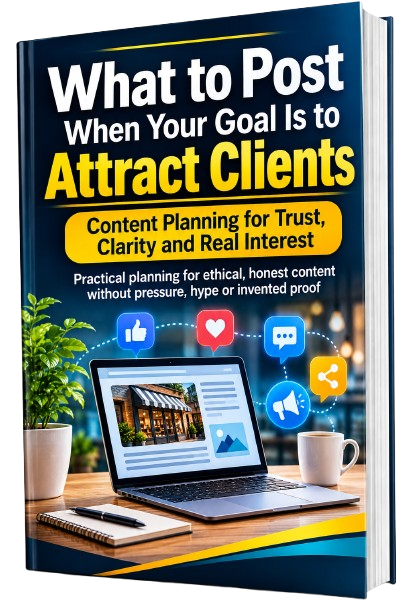
When every post starts with “What should I say?”
Posting without direction can create an exhausting cycle: selling heavily when work is needed, disappearing when nothing feels worth saying, and repeatedly starting from a blank page.
The book approaches content from a different perspective: each post can build trust, add clarity or add noise.
Plan content around trust, clarity and real interest.
What to Post When Your Goal Is to Attract Clients is an educational book for small businesses and independent professionals who sell services and want their content to help potential clients understand what they do, judge whether they are a good fit and feel respected along the way.
Content with a purpose
Instead of relying on inspiration alone, the book explains how a plan can give you topics, a publishing rhythm and a review process so content continues even when motivation is low.
Trust before the sale
Consistency, clarity, specificity, honest limits and real evidence are presented as signals that help people decide whether they can rely on a service provider.
24 chapters organized into four practical parts.
The book moves from foundations, through content types, into a working system, and finally into common mistakes, accessibility, privacy, action plans and references.
Build the Foundation
Trust, the ideal client, goals, ethics and the client journey.
Choose the Right Content
Educational content, proof of work, behind-the-scenes, FAQs, opinions and formats.
Create a Working System
Content pillars, calendar, workflow, calls to action, engagement and measurement.
Avoid Common Problems
Common mistakes, accessibility, privacy, action plans and references.
A complete framework for thoughtful client-focused content.
Every chapter focuses on a specific part of the content-planning process, from understanding your audience to reviewing what works.
Turn content from a guessing game into a clearer process.
The book focuses on practical thinking, planning and review — while keeping expectations honest.
Understand Your Ideal Client
Explore how knowing the person you want to serve affects what you choose to publish.
Build Trust Through Content
Work with consistency, clarity, specificity, honest limits and real evidence.
Answer Real Questions
Use educational content and frequently asked questions to make your communication more useful.
Choose Content Formats
Learn how different formats can be mixed without losing the focus of your content.
Create a Sustainable Rhythm
Build content pillars, calendars and workflows that fit the capacity you realistically have.
Review What Matters
Look for patterns over time instead of treating one post or one reaction as the entire story.
Concrete planning elements you can apply to your own content.
The book includes checklists, practical tools, examples, planning exercises and working structures throughout its chapters.
Clear Offer
A simple description of what you sell and for whom, without guarantees.
Idea List
A running list of possible topics to reduce blank-page days and repetitive posts.
Time Budget
A realistic amount of time per week that you can honestly give to content.
Permission Record
A simple record of what clients or collaborators have agreed to share.
Content Journey Mapping
Review recent posts, assign stages, identify gaps and plan content for missing stages.
Content Workflow
Capture, draft, check claims, confirm consent, review accessibility, publish and review performance.
Move from idea to review with a defined process.
One of the book's practical frameworks is a seven-step content workflow designed to reduce skipped checks and unsupported claims.
A 30, 60 and 90 Day perspective.
The final action-planning chapter helps readers think beyond individual posts and work with a longer learning period.
Start With Clarity
Establish what your content should help with, identify useful topics and begin applying the principles.
Review the Patterns
Look at what you have published, the responses it generated and what you would change.
Keep Learning
Treat the first ninety days as a learning period rather than a test you must pass.
Built for people who sell services.
The book is written for small businesses and independent professionals whose work depends on personal judgment and client relationships.
It can fit professionals such as:
- Designers
- Writers
- Coaches
- Consultants
- Photographers
- Tutors
- Bookkeepers
- Therapists working within their scope
- Small studios
- Owners of small teams offering repeated services
The focus is clear:
- Attracting clients for services
- Building thoughtful relationships over time
- Helping potential clients understand your work
- Communicating clearly without unnecessary jargon
- Showing real work with appropriate permission
- Creating content without pressure or manipulation
- Planning around realistic capacity
No hype. No invented proof. No guaranteed outcomes.
The book consistently emphasizes ethical, honest content and realistic expectations.
Ethical by Design
Ethics is treated as part of the planning process rather than something added after the content is written.
Real Evidence
Real work can be shared with consent, while invented praise and unexplained proof are explicitly avoided.
Clear Expectations
The book does not promise more followers, inquiries, sales or clients.
Respectful Engagement
Attention is not treated as the same thing as value. The focus is on informed, respectful relationships.
Accessibility Matters
Clear headings, plain language, image descriptions, captions and contrast are included in the workflow.
Privacy Matters
Client material, images and identifying details should be handled with appropriate permission and care.
One focused digital edition for personal use.
The product is the ebook itself: an educational resource covering content planning for client attraction across 24 chapters and four parts.
What to Post When Your Goal Is to Attract Clients
Content Planning for Trust, Clarity and Real Interest. Practical planning for ethical, honest content without pressure, hype or invented proof.
Start planning your content with more intention.
Get the digital edition and explore a practical approach to content built around trust, clarity and honest communication.
What to Post When Your Goal Is to Attract Clients
Content Planning for Trust, Clarity and Real Interest
A straightforward 7-Day Guarantee.
Your offer includes a 7-Day Guarantee.
DAYS
7-Day Guarantee
The offer includes a 7-Day Guarantee. No additional conditions or policies are stated here beyond the guarantee provided with the offer.
Questions before you get started?
What is this ebook about?
How many chapters does the book contain?
Who is the book designed for?
Does the book guarantee more clients or sales?
Does it provide individual consulting?
Does the book include practical material?
Does the book cover ethical content?
What is the price?
Is there a guarantee?
Your content does not need more pressure. It needs more purpose.
Learn how to plan content around trust, clarity and real interest — while keeping your communication honest, respectful and practical.