Gain More Financial Peace of Mind
Reducing Money Stress Step by Step — a practical educational guide for recognizing money stress, understanding how it affects your sleep, health, decisions and relationships, and building calmer routines, conversations and support.
Digital edition · Personal use by the reader
Money stress is not always about the numbers.
A money problem can be a concrete fact. Money stress is the emotional and physical response to those facts — and sometimes it can appear even when the facts are fine but the mind keeps predicting disaster.
The moment before a bill
That quiet tension before paying a bill can become a recurring source of worry.
Checking your balance
Racing thoughts, a tight chest or a faster heartbeat can appear around financial notifications.
Sleep that gets disrupted
Some people lie awake running through numbers, while others sleep more as a way of avoiding the day.
Money inside relationships
Financial worry can affect conversations with partners, family members and people you care about.
Avoiding financial tasks
Stress can show up as scrolling past payment messages or avoiding numbers altogether.
Worry influencing decisions
Stress can shape money decisions, especially when worry makes it harder to think clearly.
A step-by-step approach to understanding money stress.
Gain More Financial Peace of Mind is an educational guide about emotional well-being connected to money.
Rather than promising to remove every financial worry, the guide focuses on reducing the grip money stress can have on sleep, relationships and choices through awareness, routines, conversations and support.
The guide recognizes that some money problems are real and may require practical help. When that is the case, it points toward appropriate professionals, public services and regulated guidance rather than trying to solve everything through feelings alone.
Inside the guide, you will explore:
- How to recognize physical, emotional and behavioral signs of money stress.
- How money worry can affect sleep, health, decisions and relationships.
- How to separate financial facts from fears.
- Ways to calm the body before checking accounts.
- Short, repeatable daily and weekly money check-ins.
- Ways to create space between worry and action.
- How to talk about money at home, with a partner and with family members.
- How to set boundaries around money requests.
- How to recognize shame and avoidance around money.
- How to build a support network and know when professional help may be appropriate.
24 chapters organized around real-life money stress.
The guide is structured in four parts: Understanding, Routines, Conversations and Support.
Understanding
Chapters 1–6 explore the signs of money stress and how it reaches sleep, health, decisions and relationships.
Routines
Chapters 7–11 focus on separating facts from fears, calming the body and building short, repeatable check-ins.
Conversations
Chapters 12–17 cover talking about money at home, setting limits and building a supportive network.
Support
Chapters 18–24 cover when to seek help, country-specific resources and a gradual 90-day plan.
Simple tools that support the habits.
The guide includes practical ways to observe patterns, create routines and reflect on progress without requiring special software or expensive tools.
Self-Assessment
Establish a baseline by considering your stress level, the areas most affected, physical symptoms and who you can talk with.
Fact Log
Record observations and distinguish concrete financial facts from fears or predictions.
Five-Minute Check-In
Use a short, consistent daily check-in to notice patterns without turning money into an all-day concern.
Weekly Money Review
Review the fact log, daily notes and priorities while keeping the weekly process intentionally short.
Parking Lot List
Capture money concerns so they can be returned to at an appropriate time instead of demanding attention continuously.
Support Map
Identify people and possible sources of support and gradually build a network that can help.
From awareness to steady routines.
Chapters 22 and 23 organize the guide into a gradual 90-day process built around modest, observable changes.
Set Your Baseline
Record your stress level, sleep pattern, main concerns and possible supporters.
Practice Awareness
Observe physical, emotional and behavioral signs for seven days without judging yourself.
Add the Daily Check
Introduce a five-minute check-in at a consistent time.
Start a Supportive Talk
Arrange one conversation with someone you trust.
Complete the First Review
Set priorities for the next week and compare your stress with your baseline.
Build Through Days 31–90
Continue reviewing progress, adapting routines, strengthening support and choosing realistic next steps.
A calmer relationship with money is built step by step.
The guide focuses on realistic, observable changes rather than guaranteed financial or emotional outcomes.
Recognize Your Signals
Become more aware of physical, emotional and behavioral signs that may appear around money.
Separate Facts From Fears
Learn to distinguish concrete financial information from predictions and unresolved worries.
Build Short Routines
Use brief check-ins and weekly reviews to create a more structured way of paying attention to money.
Improve Money Conversations
Explore ways to talk about money at home, with partners and with family members.
Set Healthier Boundaries
Understand how boundaries can help when dealing with money requests from other people.
Know When to Seek Help
Learn about signs that may make a conversation with a doctor, therapist or regulated financial guidance service appropriate.
Created for adults who feel uneasy about money.
Even when finances seem manageable on paper, money can still create emotional pressure. This guide is designed around a broad range of real-life situations and life stages.
- People who live paycheck to paycheck.
- People whose income changes from month to month.
- Parents carrying the weight of household decisions.
- Students and young adults learning to manage money.
- People experiencing a job loss or major life change.
- People going through a separation or the arrival of a child.
- Partners who want to understand what a loved one may be feeling.
- Family members looking for a better way to understand money stress.
Practical, realistic and clear about its limits.
The guide deliberately avoids promising specific financial or health outcomes.
Focused on emotional well-being
It explores the connection between money and emotional well-being without presenting itself as financial advice or mental health treatment.
Built around small steps
The guide uses routines, check-ins, conversations and support rather than demanding that everything be changed at once.
Recognizes different support systems
It discusses support options across countries and encourages readers to verify current details with official sources.
No guaranteed results
The guide explicitly presents progress as gradual and modest rather than promising a specific increase in savings or precise improvement in sleep.
Asking for help is included
The guide treats professional and emotional support as a responsible part of managing serious or persistent money stress.
24 chapters with a 90-day path
The content moves from understanding money stress through routines and conversations toward support and next steps.
One complete digital guide.
Everything included in the offer is presented clearly and without unnecessary extras.
Gain More Financial Peace of Mind
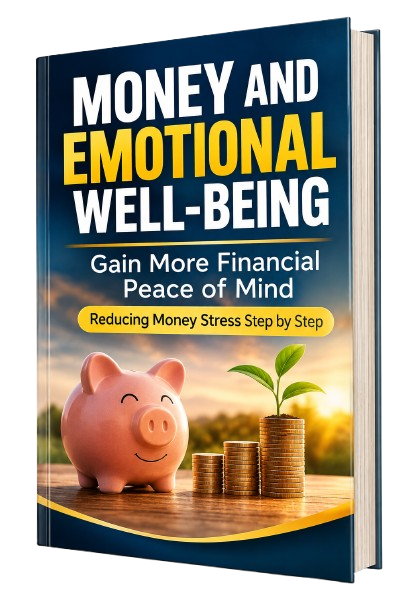
Reducing Money Stress Step by Step — 233-page digital edition with 24 chapters, including the guide's routines, conversations, support resources and gradual 30-day and 90-day plans.
Gain More Financial Peace of Mind
Reducing Money Stress Step by Step.
A complete educational guide for understanding money stress and building small, realistic steps toward a calmer relationship with money.
7-Day Guarantee
Your purchase includes a 7-Day Guarantee.
Questions about the guide?
It is an educational guide about money stress and emotional well-being. It explores how money worry can affect sleep, health, decisions and relationships, and discusses routines, conversations and support.
The guide contains 24 chapters, covering understanding, routines, conversations, support, country-specific resources, work and daily life, and gradual next steps.
No. The guide is educational and does not tell readers what to invest in, how to organize debts, or which financial products suit them.
No. The guide is not mental health treatment and does not diagnose any condition. It explains when speaking with an appropriate professional may be useful.
Yes. The guide includes a five-minute daily check-in, a short weekly money review, a calming routine before checking accounts, a fact log, a parking lot list, self-assessment and a gradual 30-day and 90-day process.
It is written for adults who feel uneasy about money, including people living paycheck to paycheck, people with changing income, parents, students, young adults, people experiencing major life changes, partners and family members.
The digital edition is offered for $9.90.
Yes. The offer includes a 7-Day Guarantee.
A calmer relationship with money starts with understanding.
Recognize money stress. Understand its effects. Build short routines. Have more intentional conversations. Know when to seek support.
Gain More Financial Peace of Mind · Digital Edition